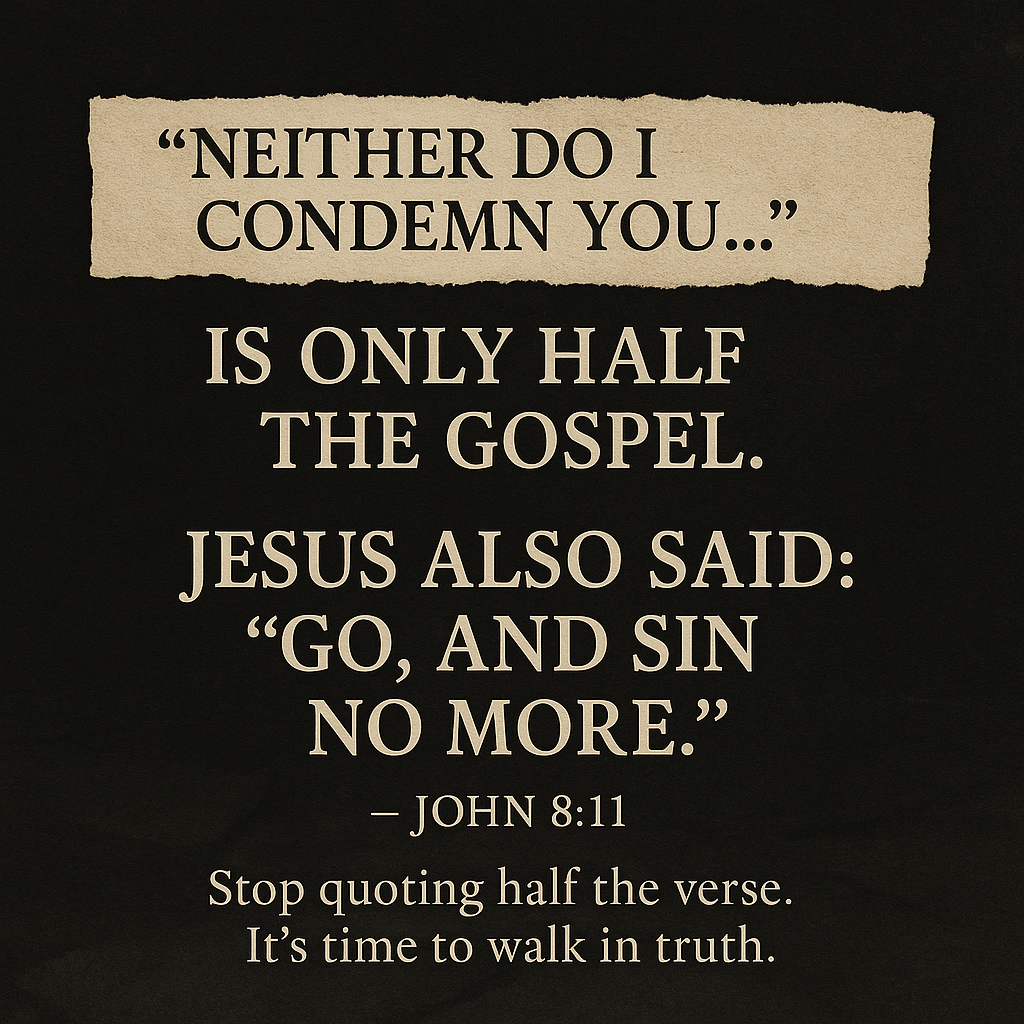
“Jesus said, ‘Neither do I condemn you.’” “So stop judging.” “We’re all sinners.” “Let people live their truth.”
But is that actually what Jesus meant?
Let’s go back to the real moment—not the soundbite version.
The Setup: A Trap Disguised as Justice
John 8 tells the story.
A woman was caught in the act of adultery. The religious leaders dragged her into the temple court and made her stand in shame before a crowd—and before Jesus.
“Now in the Law, Moses commanded us to stone such women. So what do You say?” — John 8:5
They didn’t care about holiness or repentance. They weren’t protecting the community or even applying the law correctly. They were using this woman like a pawn.
“This they said to test Him, that they might have some charge to bring against Him.” — John 8:6
It was a trap. But not just a moral one. It was legal, political, and possibly theological all at once.
A Hidden Layer in the Trap: Was This About Blasphemy Too?
There’s a deeper layer to this moment that often gets missed.
The Pharisees weren’t just setting Jesus up for political or legal trouble. They were likely laying a theological trap as well—one involving the charge of blasphemy.
Here’s how it breaks down:
1. The Roman Law Trap Under Roman rule, the Jews weren’t allowed to carry out executions. If Jesus said, “Yes, stone her,” they could report Him for inciting unlawful punishment.
2. The Mosaic Law Trap If He said, “Let her go,” they could accuse Him of breaking the Law of Moses and discredit Him among the Jews.
3. The Blasphemy Trap This was the more subtle setup.
In Jewish understanding, the ultimate authority to judge sin and pronounce condemnation belonged to God alone. So if Jesus directly said,
“I condemn her. She is guilty under My judgment,” they could accuse Him of making Himself equal with God—a charge they eventually did bring (John 10:33).
That would’ve opened the door to charge Him with blasphemy, the very accusation used to justify His arrest and crucifixion (see Matthew 26:65).
This wasn’t just about the woman. It was about trapping Jesus in a situation where any move He made could be turned against Him—legally, politically, or theologically.
But instead of falling into it, He turned it back on them with surgical precision.
The Response: Silence and Exposure
Jesus didn’t take the bait.
He stooped and wrote in the dust—something that silenced the mob. Then He stood and said:
“Let him who is without sin among you be the first to throw a stone at her.” — John 8:7
One by one, they walked away.
What He Didn’t Say
Let’s be clear.
Jesus did not say:
“Who are you to judge?”
“We all sin—it’s not a big deal.”
“She can stay in adultery. That’s between her and God.”
And He didn’t say:
“If you’re righteous, go ahead and hit her with a stone.”
That’s a fake paraphrase people use today to shut down accountability.
What He actually said was:
“Let the one without sin cast the first stone.”
Meaning: “If you’re going to enforce this law, you better be clean enough to carry it out.”
They weren’t.
The Line Everyone Quotes—Halfway
Then Jesus turned to the woman and said:
“Woman, where are they? Has no one condemned you?” She said, “No one, Lord.” And Jesus said, ‘Neither do I condemn you; go, and from now on sin no more.’” — John 8:10–11
Why Did He Say, “Neither Do I Condemn You”?
This is not because Jesus is powerless to judge. He’s not a soft-spoken guru shrugging at sin.
“The Father judges no one, but has given all judgment to the Son.” — John 5:22
“The one who rejects Me and does not receive My words has a judge… the word that I have spoken will judge him on the last day.” — John 12:48
Jesus has the authority to condemn. But during His first coming, He came not to condemn, but to offer mercy.
“For God did not send His Son into the world to condemn the world, but in order that the world might be saved through Him.” — John 3:17
He was saying: “This is not your execution day. This is your mercy window. Don’t waste it.”
And that’s why He followed it immediately with:
“Go, and sin no more.”
That’s the part people leave out.
Misusing This Verse Is Spiritual Manipulation
Today, many use Jesus’ words to:
Excuse sin.
Shut down correction.
Twist mercy into license.
But that’s not what Jesus was doing.
He offered mercy with a command to repent.
Judging Rightly vs. Hypocritically
Jesus said:
“Judge not, that you be not judged.” — Matthew 7:1
But He wasn’t banning all judgment. He clarified:
“First take the log out of your own eye, and then you will see clearly to take the speck out of your brother’s eye.” — Matthew 7:5
Paul affirmed the same:
“Is it not those inside the church whom you are to judge?” — 1 Corinthians 5:12
We are commanded to judge righteously, not self-righteously.
“Do not judge by appearances, but judge with right judgment.” — John 7:24
“The spiritual person judges all things…” — 1 Corinthians 2:15
Mercy Is Not a Hall Pass for Sin
Jesus didn’t condone adultery. He didn’t say the law was wrong. He didn’t say sin didn’t matter.
He said: “You’re standing in mercy. Don’t return to the mud.”
That’s the Gospel.
Not a free ride—but a bloody ransom. Not permission to sin—but power to walk free.
Final Word
If you only quote, “Neither do I condemn you,” and leave off, “Go and sin no more,”…
Thankfulness doesn’t mean you stop dreaming. It means you stop grumbling while you wait.
I was thinking this morning… how wanting more—when it’s not surrendered—always pushes us toward sin. It makes us discontent. Demanding. Blind to what we already have.
But thankfulness? It flips the whole thing upside down.
What the Bible actually teaches—no hype, no twisting, no AI mystery maps.
People love to say the Bible teaches a flat earth.
They’ll throw out poetic phrases like “four corners,” “circle of the earth,” or “pillars,” and claim this proves God’s Word supports ancient cosmology or conspiracies.
But if we actually read the Bible in context, and study the original Hebrew and Greek, the truth is not only different—it’s clear.
Claim #1: “The Earth has four corners.”
Revelation 7:1 “After this I saw four angels standing at the four corners of the earth, holding back the four winds of the earth…”
Isaiah 11:12 “…He will assemble the banished of Israel, and gather the dispersed of Judah from the four corners of the earth.”
Flat-earth argument: “If the earth has four corners, it must be flat like a square.”
Biblical response: This is a figure of speech—a metaphor. “Four corners” means the entire breadth and width of the earth. Even today we say “north, south, east, and west”—the four directions—without implying the planet is a cube.
The same verse speaks of “winds” coming from the four corners. Winds don’t have corners. This is poetic language, not a geography lesson.
Even flat-earth maps are circular, not rectangular. So even their own logic fails.
Claim #2: “The Earth is a circle—not a sphere.”
Isaiah 40:22 “He sits enthroned above the circle of the earth, and its inhabitants are like grasshoppers…”
Flat-earth argument: “See? Circle! That means flat like a coin.”
Biblical response: The Hebrew word used here is chûg (חוּג)—a word that describes something round or encompassed. It does not mean “disc” or “flat plate.” Hebrew has other words for that (like galgal or lûach), and they’re not used here.
This same word is used in Proverbs 8:27: “He drew a circle (chûg) on the face of the deep.”
It paints the picture of global roundness, not flatness. Even the horizon—when viewed from any direction—appears curved to the eye. God gave us that image, long before telescopes.
Claim #3: “The Bible says the Earth doesn’t move.”
1 Chronicles 16:30 “Yes, the world is established; it shall never be moved.”
Psalm 104:5 “He set the earth on its foundations, so that it should never be moved.”
Flat-earth argument: “If it doesn’t move, then the sun must go around the earth!”
Biblical response: These verses are about stability, not geophysics. The Hebrew word for “moved” here (môt) means “to slip,” “to fall,” or “to totter.” It’s about security—not literal orbital mechanics.
See Psalm 125:1: “Those who trust in the Lord are like Mount Zion, which cannot be moved…”
Does that mean Mount Zion is on a fixed axis in space? No—it means it’s firm, established, secure.
Claim #4: “God spread out the heavens like a tent.”
Isaiah 40:22 “…who stretches out the heavens like a curtain, and spreads them like a tent to dwell in.”
Psalm 104:2 “…stretching out the heavens like a tent.”
Flat-earth argument: “If God stretched out the heavens like a tent, that must mean it’s flat with a dome.”
Biblical response: This is imagery, not architecture. Hebrew poetry constantly uses metaphors. Stretching the heavens like a curtain is about God’s power and authority—not literal structure.
It’s no different than saying “He rolled up the skies like a scroll” (Isaiah 34:4).
What Does the Bible Actually Say About the Earth?
Job 26:7 “He stretches out the north over the void and hangs the earth on nothing.”
This is not a flat disc on pillars. This is a globe—suspended in space. And Job is one of the oldest books in Scripture.
Luke 17:34–36 Jesus says people will be sleeping in one part of the world and working in another—at the same time. That only happens on a rotating sphere.
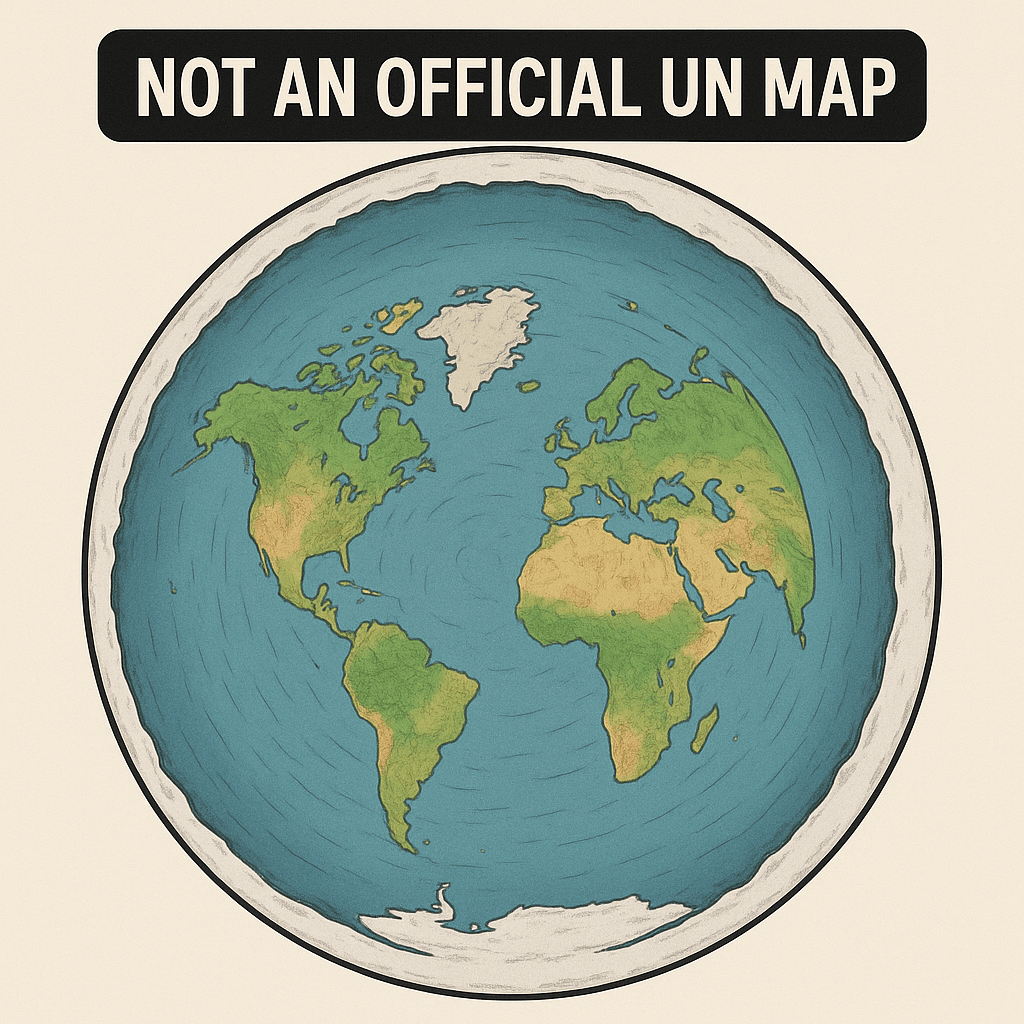
What About the UN Map?
Let’s clear the fog.
The UN map uses the azimuthal equidistant projection. It’s not a belief statement—it’s a top-down projection used for visual and diplomatic balance.
But now, fake versions—AI-generated with eerie lighting—are being passed around as “proof.” They’re not from the UN archives. They’re from YouTubers, meme makers, and those itching to spread mystery instead of truth.
The real projection simply shows the globe from above, centered on the North Pole. It’s not a declaration of a flat earth.
Who Started This Modern Flat Earth Idea?
Samuel Rowbotham — a British man in the 1800s. Not a theologian. Not a Spirit-led teacher.
He published under the pen name “Parallax,” used a few surface-level “observations,” then cherry-picked Scripture to fit his view. His book, Zetetic Astronomy, laid the groundwork for a movement based on pride, not truth.
This was never about glorifying God. It was about glorifying his own idea.
“Did God Really Say…?”
We’ve heard that before.
It started in Genesis. Now it’s disguised in memes, AI maps, and YouTube channels. But the goal is the same: make you doubt the Word of God.
If Satan can’t reverse the Cross, he’ll try to shake your trust in Scripture.
And if he can’t do that with sin, he’ll do it with confusion.
What Now?
We don’t mock. We teach. We don’t fight myths with sarcasm. We fight them with Scripture.
And we remind the Church:
Yes. God really did say.
Want the Truth?
Start with the Word.
And if you want a place where discernment is honored and truth is spoken plainly—visit Arete Gune.
Where the scroll stays steady, and the lies get sifted out.
A Follow-Up to: The Final Showdown — Gog Watch from the North
A Scroll from Arete Gune Written in the Spirit, grounded in the Word.
Why This Scroll Was Written
Because the next chess piece just moved.
On June 12, 2025, Arete Gune released the scroll “The Final Showdown — Gog Watch from the North”, exposing Iran’s nuclear push, Russia’s rising candidates for Gog, and a timeline that’s been tightening since early 2025.
“In the beginning, God created the heavens and the earth. The earth was without form and void, and darkness was over the face of the deep. And the Spirit of God was hovering over the face of the waters. And God said, ‘Let there be light,’ and there was light. And God saw that the light was good. And God separated the light from the darkness. God called the light Day, and the darkness He called Night. And there was evening and there was morning, the first day.” — Genesis 1:1–5
Before the stars were hung, Before the sun was set in motion, Before the moon began her rhythm…
God said one thing:
“Let there be light.”
And just like that— The deep waters, the formless earth, the silent darkness— were clothed in something new.
Earth Was a Womb
It was watery. Covered. Unformed. Yet chosen.
The Spirit hovered like a mother eagle over her nest (Deuteronomy 32:11). And then, the first Word ever spoken pierced the silence:
“Let there be light.”
This light didn’t come from the sun—it hadn’t even been created yet (that came on Day 4). This was glory-light, from the very breath of God.
And that light? It didn’t just shine. It sealed.
Science Caught Up to Scripture
Today, biologists have seen something astounding: At the moment of human conception—when the father’s sperm meets the mother’s egg…
A tiny flash of light is released.
Not poetry. Not metaphor. Actual light.
It’s called the zinc spark.
Zinc ions burst in a bright flare the very moment life begins. And once that flash happens?
The egg seals itself.
One light. One entry. One life.
“I am the door. If anyone enters by Me, he will be saved…” — John 10:9
Zinc: The Silent Servant of Creation
What does zinc do?
– It triggers light at the start of conception. – It activates DNA so life can begin forming. – It protects the identity being written inside the cell. – It seals the egg from any other intruder—only one may enter.
Zinc doesn’t just support life. It announces it.
It says: “This one is chosen.” “This one is sealed.” “This one bears the image.”
It’s the Genesis 1 moment, written into every human womb.
Adam and Eve Were Covered in Light
“The man and his wife were both naked and were not ashamed.” — Genesis 2:25
Yes—they were physically naked. But they were also literally clothed in light and glory.
– Psalm 104:2 — God covers Himself with light as with a garment. – Moses’ face shone after being near God. – Jesus radiated light at the transfiguration. – Angels appear as shining beings. – And the righteous will one day shine like the sun (Matthew 13:43).
Before the fall, Adam and Eve weren’t walking in shame. They were radiant—not just spiritually, but visibly glowing with God’s presence.
They were clothed in light.
Until they weren’t.
The Fall Snuffed Out the Flame
“Then the eyes of both were opened, and they knew that they were naked…” — Genesis 3:7
When they sinned, the glory covering vanished. The radiance went out. And they saw their flesh—raw, unshielded, ashamed.
So they reached for fig leaves— A poor substitute for what had been lost.
And God, in mercy, clothed them in animal skins. But the light? The true covering? Wouldn’t return until the Lamb was revealed.
Jesus—the Light We Lost
“In Him was life, and the life was the light of men.” — John 1:4 “I am the Light of the world.” — John 8:12
When He came, the light returned. When He died, the veil tore. When He rose, the glory was no longer hidden.
And when we believe?
“You are all sons of God through faith in Christ Jesus. For as many of you as were baptized into Christ have put on Christ.” — Galatians 3:26–27
We don’t just follow the Light. We are clothed in Him again.
From the First Day to the Final Day
It began with light. It continues with light. And in the end?
“Night will be no more. They will need no light of lamp or sun, for the Lord God will be their light.” — Revelation 22:5
You weren’t biology. You were spoken into being.
And the same voice that hovered over the waters… The same spark that sealed the egg… The same Word that radiated in Eden…
Still speaks today:
“Let there be life.”
And if you belong to Him?
Then one day—you’ll shine again.
Postscript: Fig Leaves and Foolishness
To those who say:
“Well, Adam and Eve were naked, so let’s get naked too…”
Yes—they were naked. But they were clothed in glory, not driven by lust. They walked in innocence, not Instagram reels.
They weren’t sensual. They were spiritual.
They lost that covering when sin entered. And we don’t get it back through rebellion.
If you want Eden back?
Be clothed in righteousness. Walk in holiness. Be sealed by the Light before shedding layers.
Because the goal was never to be naked in skin. It was to be radiant in Him.
“Remember the Sabbath day, to keep it holy.” — Exodus 20:8
This wasn’t a human idea. The Sabbath was blessed and made holy by God Himself (Genesis 2:3). And though Jesus fulfilled the Sabbath, He never revoked its holiness.
“The Son of Man is Lord even of the Sabbath.” — Mark 2:28
As followers of Christ, we honor Him by understanding what Sabbath truly means now—not legalism, but rest in Him.
Christmas has become a point of growing skepticism in the Church — even among believers who affirm the Trinity, study the Word, and sincerely mean well.
So why do so many fall for the idea that Christmas is “pagan”?
Here’s a layered answer — not to shame anyone, but to clarify the truth:
A scroll for the parents holding the line when love means letting go
There’s a part of the prodigal son story that we rarely talk about.
Not the pigpen. Not the welcome home. But that moment before he leaves— The moment he looks his father in the eye and says:
“Father, give me the share of the property that is coming to me.” — Luke 15:12 (ESV)
It doesn’t say there was an argument. But if you’re a parent, you already know— there was tension. There was pain. There was a heart already gone long before the feet walked away.
Sometimes they don’t just ask for distance. They demand your blessing over rebellion. They want you to affirm a life that contradicts everything God said is holy—and still call it love.
And when you don’t… You’re the one called biased. Hypocrite. Outdated. Unsafe. Unloving.

 Arete Gune: The Name on the White Stone