We hear it everywhere:
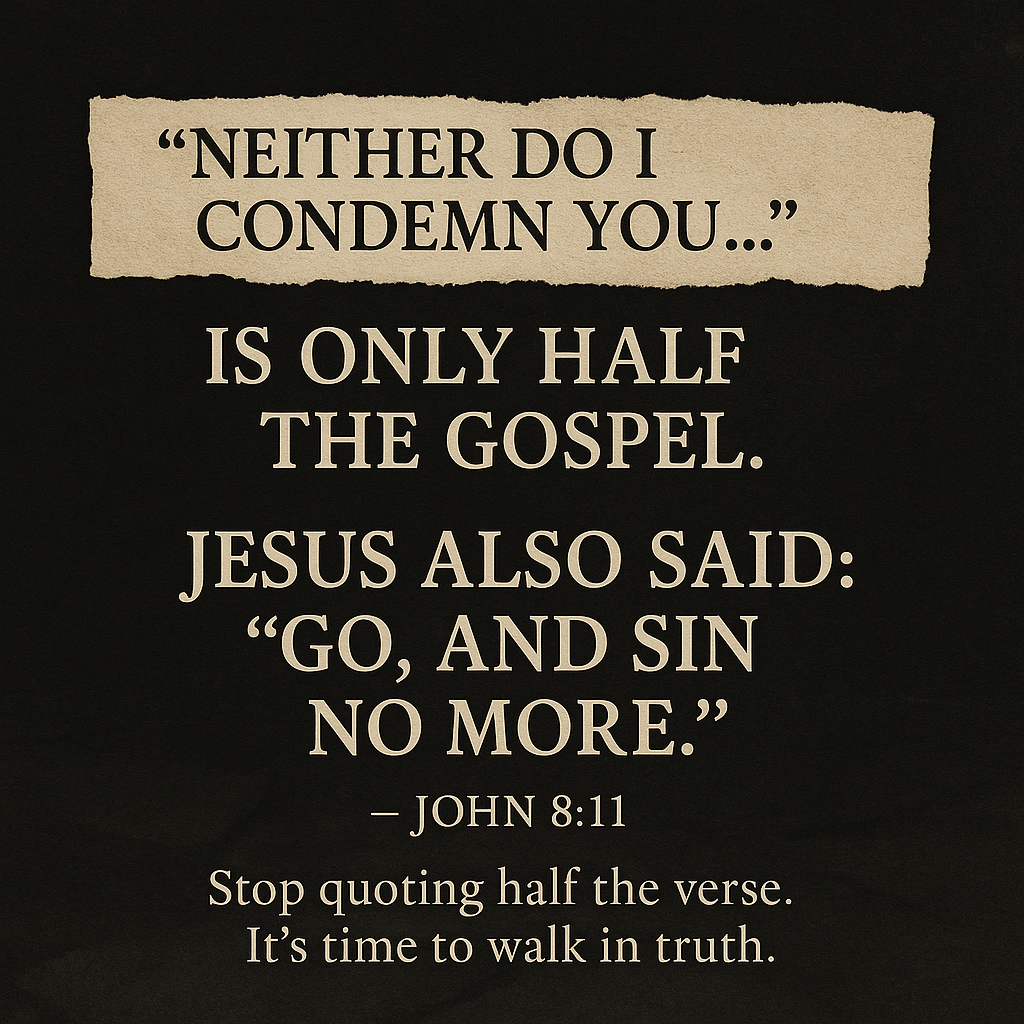
“Jesus said, ‘Neither do I condemn you.’”
“So stop judging.”
“We’re all sinners.”
“Let people live their truth.”
But is that actually what Jesus meant?
Let’s go back to the real moment—not the soundbite version.
The Setup: A Trap Disguised as Justice
John 8 tells the story.
A woman was caught in the act of adultery. The religious leaders dragged her into the temple court and made her stand in shame before a crowd—and before Jesus.
“Now in the Law, Moses commanded us to stone such women. So what do You say?”
— John 8:5
They didn’t care about holiness or repentance. They weren’t protecting the community or even applying the law correctly. They were using this woman like a pawn.
“This they said to test Him, that they might have some charge to bring against Him.”
— John 8:6
It was a trap. But not just a moral one. It was legal, political, and possibly theological all at once.
A Hidden Layer in the Trap: Was This About Blasphemy Too?
There’s a deeper layer to this moment that often gets missed.
The Pharisees weren’t just setting Jesus up for political or legal trouble. They were likely laying a theological trap as well—one involving the charge of blasphemy.
Here’s how it breaks down:
1. The Roman Law Trap
Under Roman rule, the Jews weren’t allowed to carry out executions. If Jesus said, “Yes, stone her,” they could report Him for inciting unlawful punishment.
2. The Mosaic Law Trap
If He said, “Let her go,” they could accuse Him of breaking the Law of Moses and discredit Him among the Jews.
3. The Blasphemy Trap
This was the more subtle setup.
In Jewish understanding, the ultimate authority to judge sin and pronounce condemnation belonged to God alone. So if Jesus directly said,
“I condemn her. She is guilty under My judgment,”
they could accuse Him of making Himself equal with God—a charge they eventually did bring (John 10:33).
That would’ve opened the door to charge Him with blasphemy, the very accusation used to justify His arrest and crucifixion (see Matthew 26:65).
This wasn’t just about the woman.
It was about trapping Jesus in a situation where any move He made could be turned against Him—legally, politically, or theologically.
But instead of falling into it, He turned it back on them with surgical precision.
The Response: Silence and Exposure
Jesus didn’t take the bait.
He stooped and wrote in the dust—something that silenced the mob. Then He stood and said:
“Let him who is without sin among you be the first to throw a stone at her.”
— John 8:7
One by one, they walked away.
What He Didn’t Say
Let’s be clear.
Jesus did not say:
- “Who are you to judge?”
- “We all sin—it’s not a big deal.”
- “She can stay in adultery. That’s between her and God.”
And He didn’t say:
“If you’re righteous, go ahead and hit her with a stone.”
That’s a fake paraphrase people use today to shut down accountability.
What He actually said was:
“Let the one without sin cast the first stone.”
Meaning:
“If you’re going to enforce this law, you better be clean enough to carry it out.”
They weren’t.
The Line Everyone Quotes—Halfway
Then Jesus turned to the woman and said:
“Woman, where are they? Has no one condemned you?”
She said, “No one, Lord.”
And Jesus said, ‘Neither do I condemn you; go, and from now on sin no more.’”
— John 8:10–11
Why Did He Say, “Neither Do I Condemn You”?
This is not because Jesus is powerless to judge. He’s not a soft-spoken guru shrugging at sin.
“The Father judges no one, but has given all judgment to the Son.”
— John 5:22
“The one who rejects Me and does not receive My words has a judge… the word that I have spoken will judge him on the last day.”
— John 12:48
Jesus has the authority to condemn. But during His first coming, He came not to condemn, but to offer mercy.
“For God did not send His Son into the world to condemn the world, but in order that the world might be saved through Him.”
— John 3:17
He was saying:
“This is not your execution day. This is your mercy window. Don’t waste it.”
And that’s why He followed it immediately with:
“Go, and sin no more.”
That’s the part people leave out.
Misusing This Verse Is Spiritual Manipulation
Today, many use Jesus’ words to:
- Excuse sin.
- Shut down correction.
- Twist mercy into license.
But that’s not what Jesus was doing.
He offered mercy with a command to repent.
Judging Rightly vs. Hypocritically
Jesus said:
“Judge not, that you be not judged.”
— Matthew 7:1
But He wasn’t banning all judgment. He clarified:
“First take the log out of your own eye, and then you will see clearly to take the speck out of your brother’s eye.”
— Matthew 7:5
Paul affirmed the same:
“Is it not those inside the church whom you are to judge?”
— 1 Corinthians 5:12
We are commanded to judge righteously, not self-righteously.
“Do not judge by appearances, but judge with right judgment.”
— John 7:24
“The spiritual person judges all things…”
— 1 Corinthians 2:15
Mercy Is Not a Hall Pass for Sin
Jesus didn’t condone adultery.
He didn’t say the law was wrong.
He didn’t say sin didn’t matter.
He said:
“You’re standing in mercy. Don’t return to the mud.”
That’s the Gospel.
Not a free ride—but a bloody ransom.
Not permission to sin—but power to walk free.
Final Word
If you only quote, “Neither do I condemn you,” and leave off, “Go and sin no more,”…
You’re preaching half a gospel.
And a half gospel can’t save anyone.
 Arete Gune: The Name on the White Stone
Leave a comment