Some pastors, meaning well, tell the anxious to steady themselves with God’s Name. They say, “Breathe in Yah… breathe out Weh.” And yes, there is a sweetness to remembering that life itself is a gift of God, that every breath we take is sustained by His mercy. But His Name is not simply a breathing technique.
The Name יהוה — Yahweh — appears more than 6,800 times in the Hebrew Scriptures. It is not poetry alone, but revelation: “I AM WHO I AM.” (Exodus 3:14) The Eternal One, self-existent, unchanging, the One “who was and is and is to come” (Revelation 1:8). His Name is not merely on our breath — His Name is our breath, our being, our existence.
And yet, it was that number — 6,800 — that caught the eye and tugged the thread. A half-joke: “After 6,800 years will He come again?” But tugging that thread unravels a hidden story: how the clock of history was kept, how prophecy was given, and how men who denied Christ sought to blur what God had made clear.
The Prophetic Clock
The genealogies in Genesis are not filler. They are the bones of the calendar of the world. From Adam to Noah, from Shem to Abraham, the years are counted, each name bearing witness to the march of time.
In the Septuagint (the Greek Scriptures translated two centuries before Christ and widely read in His day), the numbers stretch long: Adam to Abraham is about 3,200 years. In the later Masoretic Text, fixed by Jewish scribes after the destruction of the Temple, those same years shrink to about 2,000. More than a millennium cut away by the scribe’s pen.
Why should this matter? Because God gave Daniel a clock:
“From the issuing of the decree to restore and rebuild Jerusalem until Messiah the Prince, there will be seven ‘sevens’ and sixty-two ‘sevens.’ … After the sixty-two ‘sevens,’ Messiah shall be cut off, but not for Himself. And the people of the prince to come shall destroy the city and the sanctuary.” (Daniel 9:25–26)
The Hebrew word for “sevens” (shavuim) means “weeks” of years. One “seven” = seven years. Thus:
- Seven sevens = 49 years.
- Sixty-two sevens = 434 years.
- Together, 69 sevens = 483 years.
Daniel’s prophecy foretold: from the decree to rebuild Jerusalem, there would be 483 years until Messiah came. After that, He would be cut off, and the city and Temple would be destroyed.
And history bore it out: Jesus crucified around A.D. 30–33, “cut off, but not for Himself.” Then in A.D. 70, the city and sanctuary burned, exactly as Daniel said. The prophetic clock struck true.
The Rabbinic Response
But what of those who rejected Him? The Temple was gone, sacrifices ended, prophecies fulfilled in the Nazarene they refused to follow. They could not erase Daniel. They could not undo Calvary. But they could blur the clock.
By trimming genealogies, the rabbis could make the world appear “younger.” They could claim: “It is too soon. Messiah has not yet come. Jesus cannot be the One.” Thus was born rabbinic Judaism — not the faith of Abraham and Moses, but a new structure built on denial.
Their writings — the Talmud — admit uneasily that Daniel gave a timetable. In Sanhedrin 97a, rabbis lament: “All the appointed times for Messiah’s coming have already passed.” Others claim He was “delayed” because of Israel’s sins. Still others deflect, saying Israel herself is the suffering one. Anything but Jesus. Anything but the Christ who fit Daniel’s words exactly.
Witnesses of the Early Church
The early Christians saw this tampering clearly.
- Julius Africanus (c. 160–240 A.D.) accused the Jews of shortening the genealogies “so that their own Scriptures might not show the Christ as having already come.”
- Eusebius (c. 260–340 A.D.), the father of church history, preserved Africanus’s testimony and added his own: the Hebrews altered their numbers so that Christ’s coming might “seem still in the future.”
- Irenaeus (c. 130–202 A.D.), bishop of Lyons, spoke of the six-thousand-year pattern: as God made the world in six days and rested on the seventh, so history would run for six “days” (6,000 years) before the millennial reign of Christ, the seventh day of rest. “In as many days as this world was made, in so many thousand years shall it be concluded.” (Against Heresies 5.28.3)
But Irenaeus did not invent this. He had learned it at the feet of Polycarp of Smyrna, who himself had been a disciple of the apostle John, the beloved, the seer of Patmos, who leaned on Christ’s chest at the Supper and saw the visions of Revelation.
Polycarp’s witness was sealed in fire and blood. At eighty-six years old, arrested by Rome and commanded to deny Christ, he replied:
“Eighty and six years have I served Him, and He has done me no wrong. How then can I blaspheme my King and my Savior?”
They lit the fire, but the flames bent away, arching like a vault. At last, he was pierced with the sword, and his blood quenched the blaze. Such was the faith of the man who had known John, and such was the legacy passed to Irenaeus.
Thus we see a chain unbroken: John the Apostle → Polycarp the Martyr → Irenaeus the Bishop. And together with Africanus and Eusebius, they testified that the Scriptures had been altered by men, but the prophetic clock still pointed unerringly to Jesus.
Clarifying the Six Thousand Years
Here many stumble, and it is no wonder. If Irenaeus spoke of six thousand years of toil followed by the seventh of rest, and if the Septuagint’s numbers stretch history to over seven thousand already, then are we not already in the millennium? Is this why some today claim the seventh day has come?
But here is the safeguard: Irenaeus was not giving a stopwatch. He was giving a pattern. Six days of creation, then a seventh of rest — so too the story of history. It is a picture of God’s design, not a calendar we can plot down to the year.
Daniel’s prophecy was precise — seventy weeks, Messiah cut off, Temple destroyed — and fulfilled to the letter. But Irenaeus’s six-thousand-year scheme was never meant as an exact countdown. It was a rhythm, a theological vision of God’s plan.
Those who claim “the millennium is already here” mistake symbolism for arithmetic. For Revelation 20 tells us plainly: the millennium begins when Christ returns in glory, when Satan is bound, when the martyrs are raised to reign with Him. Look at the world — has this happened yet? No. The deceiver still prowls, nations still rage, and the dead in Christ still await resurrection. The kingdom is not yet visible, therefore the millennium is not yet come.
So the Septuagint’s longer count does not mean we missed it. It means only this: the clock is nearly finished. Whether six thousand or seventy-two hundred, the end of man’s age is close. The Bridegroom tarries only until the Father’s appointed hour.
Then and Now
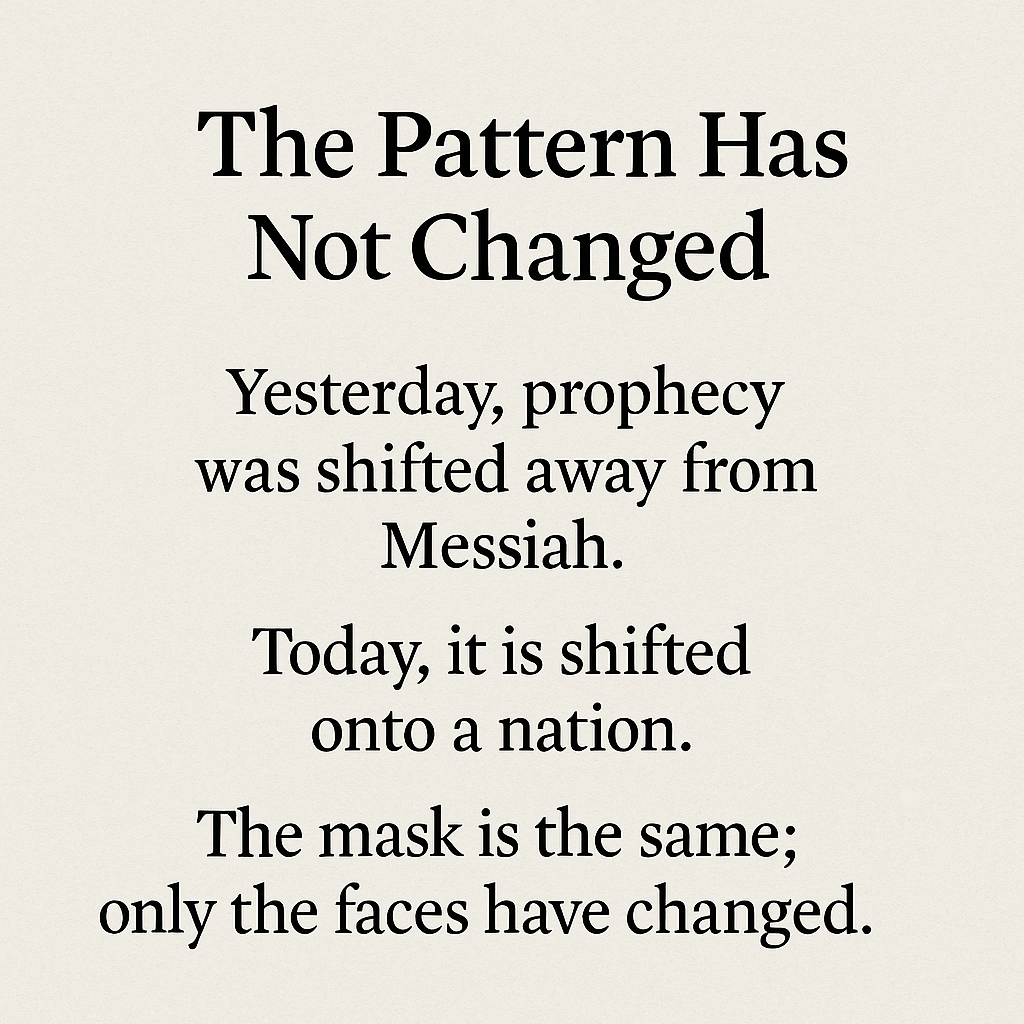
The pattern has not changed. The rabbis once shifted Daniel’s prophecy onto King Agrippa or onto Israel’s sufferings. Today, many modern voices do the same, shifting prophecy onto the modern State of Israel and insisting that loyalty to her flag is loyalty to God. And when corruption is exposed, they silence rebuke by branding it ‘antisemitism.’ The mask is the same; only the faces have changed.
But the Word does not flatter nations. The prophets thundered:
- “You only have I known of all the families of the earth; therefore I will punish you for all your iniquities.” (Amos 3:2)
- “How the faithful city has become a harlot! Your rulers are rebels and companions of thieves.” (Isaiah 1:21–23)
- “Not all who are descended from Israel belong to Israel.” (Romans 9:6)
- And to the church of Christ: “You are a chosen race, a royal priesthood.” (1 Peter 2:9)
True Israel is the remnant who believe in the Messiah, whether Jew or Gentile. To exalt a nation above the Son of God is to wear a mask of piety while bowing to an idol.
Every Breath, Every Year
And so we return to the Name. Yahweh — not a mere breathing exercise, but the everlasting “I AM.” Every breath testifies to Him, every year advances His plan. Whether six thousand or seventy-two hundred, the clock is nearly full.
Messiah has already come, cut off as Daniel foresaw. The Temple has already fallen, as prophecy decreed. And now we wait for the final unveiling — the day known only to the Father.
“But concerning that day and hour no one knows, not even the angels of heaven, nor the Son, but the Father only.” (Matthew 24:36)
Here Jesus shut our mouths from date-setting. No chart, no code, no secret math will unlock the exact hour. Yet in the very same breath He opened our eyes:
“As soon as the fig tree’s branch becomes tender and puts out its leaves, you know that summer is near. So also, when you see all these things, you know that He is near, at the very gates.” (Matthew 24:32–33)
The signs He gave are not small or local. They are global: nations rising against nations, lawlessness multiplied, love grown cold, persecution of the saints across the world, false prophets drawing multitudes, and the gospel proclaimed to every nation. These are not the tremors of one city — they are the groanings of the whole earth. And now, in our generation, they have reached a scope no age before us has seen.
So here is the balance: we cannot set the day or the hour, but we must discern the season. The Bridegroom has warned us — not so we may calculate, but so we may stay awake. Not so we may boast in secret knowledge, but so we may endure to the end.
Therefore, every breath still whispers His Name. Every year still hastens His return. The end is nearer than when we first believed. And the call remains:
“Watch therefore, for you know neither the day nor the hour.” (Matthew 25:13)
✦ This is the scroll: from breath to prophecy, from genealogies to martyrdom, from distortion to fulfillment. Julius Africanus exposed the alteration. Eusebius preserved the witness. Polycarp sealed it in flame and blood. Irenaeus proclaimed the six-thousand-year plan. And through them all, the testimony is one: Jesus is Messiah. Yahweh is Lord. His Word is true.
 Arete Gune: The Name on the White Stone
Leave a comment