(A Scroll on Laodicea — Revelation 3:14–22)
This is Jesus speaking to Laodicea—the lukewarm church. One of the seven.
And His words here? They aren’t soft. They cut.
Let’s walk through it one line at a time—biblically, spiritually, and personally.
“You say, ‘I am rich. I have everything I want. I don’t need a thing!’”
That’s the lie of self-sufficiency.
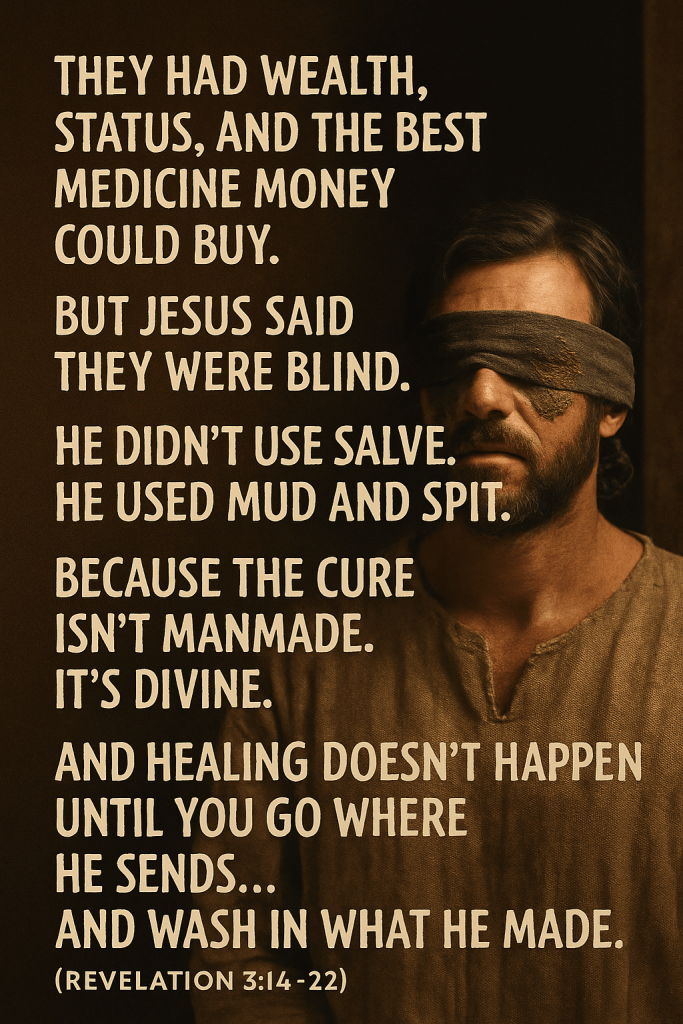
They had wealth, reputation, influence—but not Jesus.
And it’s the opposite of what He said in the Sermon on the Mount:
“Blessed are the poor in spirit, for theirs is the kingdom of heaven.”
— Matthew 5:3
Laodicea was rich. Banking hub. Known for luxury clothing, black wool, and a medical school that sold healing salves.
So Jesus hits right where they’re proud—and shows them what they’re missing.
“But you don’t realize that you are wretched and miserable and poor and blind and naked.”
It’s one thing to be poor.
It’s another thing to be poor and think you’re rich.
That’s spiritual blindness.
Jesus gives five words here: wretched, miserable, poor, blind, and naked.
Each one cancels out Laodicea’s brag sheet.
He’s not describing outward failure—He’s calling out the condition of the soul.
They looked alive, but He saw the rot underneath.
This is the prodigal before he wakes up in the pigpen.
The eye salve everyone trusted…
Laodicea was proud of its medical school. They made and sold eye ointment—called Phrygian powder. It was famous. Expensive. People believed it healed blindness.
But what if it didn’t?
What if people kept getting infections because of dirty water or poor hygiene… and all they did was rub salve on it?
What if it never touched the root issue?
Sounds familiar, doesn’t it?
Many cancers have been linked to parasites, though it’s often ignored.
Instead of addressing the root, we’re told to take $10,000 chemo over a $10 dewormer.
The system manages symptoms—it rarely goes after the cause.
Jesus wasn’t impressed with manmade salves.
Because Jesus once healed a blind man using mud and spit.
“He spat on the ground, made mud with the saliva, and spread the mud on the man’s eyes.”
— John 9:6
He could have spoken.
But instead, He bent down and used dirt—the same dirt Adam was made from.
It wasn’t about the ingredients.
It was about the Source.
Jesus is not just a prophet or miracle-worker.
He is God in flesh—the same One who created us in Genesis.
And when He formed Adam from the dust… what do you think He used?
His breath, yes—but also His saliva.
Saliva isn’t empty.
It carries everything required for life and healing.
And in that moment, Jesus re-enacted Eden.
He placed Himself—His living essence—into the dust once again.
What’s in saliva?
When Jesus spit into the dirt, He wasn’t being poetic.
He was placing what only the Creator could give—everything required to form and restore a human being:
- 🧬 DNA — His divine code. The imprint of the image of God.
- 🦠 Enzymes — for breaking down the old and restoring the new.
- 🛡️ Antibodies — defenders to fight what corrupts and infects.
- 🌀 Hormones — messengers that bring balance and order to the body.
- 🧠 Neuropeptides — molecules that link mind, emotion, and immune function.
- 💧 Electrolytes and minerals — the elements that make life flow and nerve signals fire.
- 🔥 Life-breath (by implication) — when His Word, spit, and will combine… creation begins again.
This wasn’t symbolic—it was physical. Tangible. Eternal.
He didn’t borrow man’s medicine.
He used what He used the first time.
The same hands that formed Adam were now forming sight in a blind man.
The same DNA that made Eve was now restoring what Laodicea’s medicine could never touch.
And even then—healing didn’t happen until the man obeyed:
“Go, wash in the Pool of Siloam…”
And now… about that pool He sent him to:
Jesus didn’t just say, “Go wash.”
He named the place. That means something.
Siloam wasn’t random.
It was specific. Intentional. Symbolic.
First, the name itself:
Siloam means “Sent.”
(And John tells you that straight up.)
So Jesus—the One sent by the Father—tells a blind man:
“Go wash in the place called Sent.”
That’s not poetic.
That’s prophetic.
Jesus was showing him—and everyone watching—
“If you want to see, you have to trust the One who was sent.”
Laodicea couldn’t do that.
They trusted their system. Their salve. Their wealth.
They wouldn’t go.
They wouldn’t wash.
So they stayed blind.
Second, this wasn’t just water.
The Pool of Siloam was fed by the Gihon Spring—the only living water source in the city.
And it was used for ritual cleansing before worship.
That’s right. You washed here before going up to the Temple.
So this wasn’t just about healing his eyes.
It was about preparing him to see the Lamb.
It’s a foreshadowing of baptism.
- Go where He sends.
- Wash in what’s clean, not manmade.
- Come back seeing—not just with eyes, but with understanding.
“So I advise you to buy gold from Me—gold that has been purified by fire.”
He’s not talking about coins or status or fame.
He’s talking about faith that’s been refined in fire.
“…the tested genuineness of your faith—more precious than gold…”
— 1 Peter 1:7
Laodicea thought they had it all.
But He says, “You’re naked.”
They thought they could see.
He says, “You’re blind.”
They thought they didn’t need a thing.
He says, “You need Me.”
So what now?
Verse 19 gives the answer:
“Those whom I love, I rebuke and discipline. So be earnest and repent.”
That’s mercy.
He doesn’t expose to destroy.
He exposes so they’ll return.
And then that line everyone knows, but few really hear:
“Behold, I stand at the door and knock…”
— Revelation 3:20
He’s not just knocking on hearts.
He’s knocking on the church door.
And He’s on the outside.
That should shake us.
Where does this hit us today?
If we’ve built churches, ministries, platforms, and programs—but left Jesus out of the center—we’re Laodicea.
If we think we’re good, self-sufficient, clean, and successful—but we aren’t walking in repentance, obedience, and truth—we’re blind.
Jesus is still knocking.
Will we let Him in—or just keep rubbing on more salve?
“He who has an ear, let him hear what the Spirit says to the churches.”
Selah.
 Arete Gune: The Name on the White Stone
Leave a comment