Isaiah 52:14 stopped me cold—because I finally saw what He endured. Not just bruised. Not just beaten. But unrecognizable… for me.
Hebrew (Isaiah 52:14)
כַּאֲשֶׁר שָׁמְמוּ עָלֶיךָ רַבִּים כֵּן מִשְׁחַת מֵאִישׁ מַרְאֵהוּ וְתוֹאַרוֹ מִבְּנֵי אָדָם
Transliteration:
Kă’asher shamemu aleikha rabbim, ken mishchat me’ish mar’eihu, v’to’aro mibnei adam
WORD-BY-WORD DIGGING
שָׁמְמוּ (shamemu) – “were appalled” or “devastated in horror”
From shamem — to be stunned, devastated, astonished. This isn’t just surprise—it’s frozen-in-place shock.
מִשְׁחַת (mishchat) – “marred”
From shachath — to destroy, defile, disfigure. Not a surface wound—this word is used for corruption, ruin, devastation.
- Genesis 6:12 – The earth was “corrupted”
- Leviticus 22:25 – An unfit, blemished offering
- Psalm 14 – Mankind “turned aside and become corrupt”
So here it’s saying: His appearance was ruined beyond what a man should look like.
מֵאִישׁ מַרְאֵהוּ (me’ish mar’eihu) – “more than any man was his appearance”
He didn’t even look human anymore.
וְתוֹאַרוֹ מִבְּנֵי אָדָם (v’to’aro mibnei adam) – “his form beyond the sons of men”
Even His body didn’t resemble mankind. A total breaking of what we consider human.
SUMMARY IN PLAIN TERMS
He wasn’t just bruised.
He wasn’t just bleeding.
He was so torn, disfigured, and swollen… that when people saw Him, they didn’t see a man anymore. They saw a horror.
TIE-IN TO THE CRUCIFIXION
This verse precedes Isaiah 53—and sets the scene.
Before Jesus even reached the cross, He had already been:
- Beaten by temple guards
- Scourged with a Roman flagrum (whip tipped with bones or lead)
- Crowned with thorns
- Spit on, stripped, mocked
- Then nailed to wood
Isaiah didn’t write this as an exaggeration. He was shown what we did to Him.
ISAIAH 52:14 — THE SHIFT THAT BREAKS THE “ISRAEL” THEORY
“As many were astonished at you — so marred was his appearance…”
Wait—why the switch? Why shift from “you” to “his” in one breath?
Because this isn’t about Israel.
This is a prophetic shift—from collective to individual.
- “You” = the servant being introduced
- “His” = the One others are now seeing
If it were just about Israel, Isaiah would’ve said:
“They were appalled at you—your appearance was marred…”
But instead, he draws a sharp, divine line. This is someone else. Someone alone.
Even Jewish Scholars Struggle with This
Michael L. Brown:
“The grammatical whiplash in 52:14 undermines the national-Israel interpretation.”
Franz Delitzsch:
“It is a shift in prophetic focus—from speaking about the servant to describing what others see in him.”
Dear Jewish Reader…
If you’ve never read Isaiah 53 with an open heart—please do.
Ask yourself:
Who else but Jesus of Nazareth fits this?
Who else was disfigured… rejected… silent… and still called righteous?
Isaiah 53:2–3 — Continuing the Revelation
“He had no form or majesty that we should look at him,
and no beauty that we should desire him.
He was despised and rejected by men,
a man of sorrows, and acquainted with grief…”
This is not about ugliness.
It’s about being unwanted.
It’s about being refused, abandoned, discarded.
It’s about Jesus.
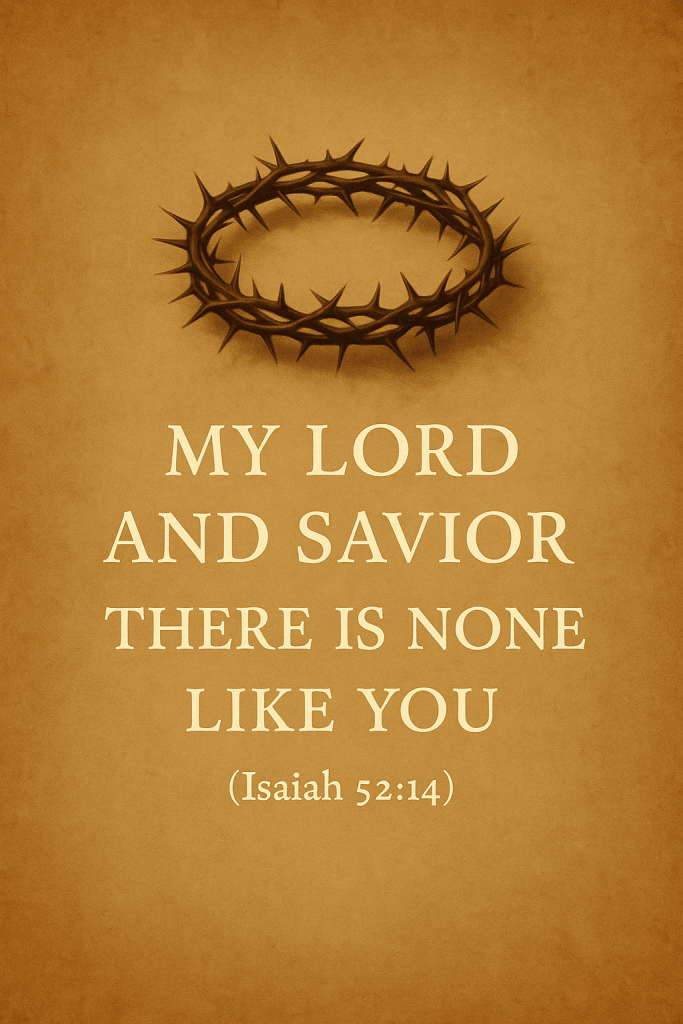
MY JESUS, MY SAVIOR — THERE IS NONE LIKE YOU
When I read:
“His appearance was so marred, beyond human semblance…”
…I couldn’t stop crying.
As a child, I sang:
“Jesus loves me, this I know…”
Then later:
“Jesus saved me—now I’ll go to heaven.”
Eventually:
“Lord, help me. Protect me. Provide…”
But I never really stopped and asked:
“What did it cost You?”
This verse broke me.
Like a child opening a gift on Christmas—excited, but unaware that the wrapping paper was soaked in blood.
Now I know.
His wounds weren’t poetic.
They were real.
They were brutal.
And they were mine to bear—until He bore them for me.
There is truly none like You.
 Arete Gune: The Name on the White Stone
Leave a comment